In the mid-19th century, the rapids' hydropower and untouched forests attracted the sawmill industry to Kerkonkoski. Workers moved to the area. The community's population structure became more diverse, as did its services. Among other things, Rautalammi's first school, a factory school, was established in 1864. Prosperity increased, even though there were years of famine. The era of industrialization touched Kerkonkoski, and the locals began to talk about Ruukki (bruk). New steam sawmills on the coast soon eclipsed the importance of hydropower, but there was a need to transport timber to industrial centers on the coast or along the developing railway network.
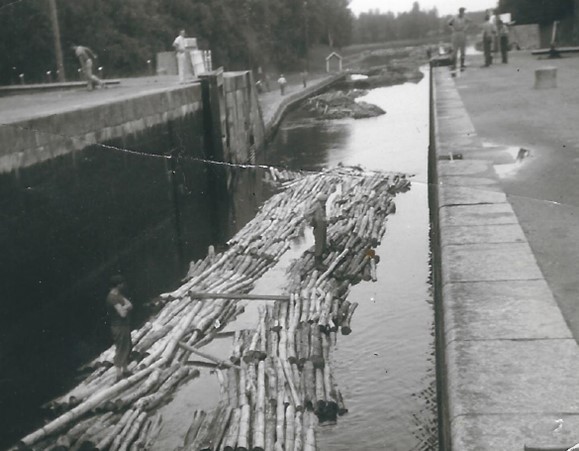
Between the large lakes at different levels of the water system, there were isthmuses or rapids that required the construction of canals. In 1927, the Iisvesi–Konnevesi–Keitele canal route was completed. Later, in 1994, the Keitele–Päijänne canal was completed. Kerkonkoski gained an element that is an essential part of the village's appearance and image: the canal and the swing bridge. There was a traffic sign at the bridge: "30 päiväsakon uhalla kielletään juosten ajo sillalla.When the canal switched to self-service, a new high bridge was built in 1969, which ships could pass under, and the swing bridge was removed. Log floating, log pulling, steamboats, tugboats, and the hustle and bustle of the canal were an essential part of the village's summer life and atmosphere. With the transition from timber floating to wheeled transport, the canal now serves recreational boating.
In the mid-20th century, the village had three shops, a bank, a post office, a health clinic, cafés, a bar, and other services, as well as active cultural, social, sports, and other activities. The school was bustling with competition and excitement. At least ten bus routes a day brought people to and from the village.