Historiaa
Jukka Vesterinen and Lena Lindroth-Vesterinen
What before?
The Kerkonkoski region was under water during the Yoldia Sea period approximately 9,700 years ago. The three highest mountains were visible as islands: Palvavuori, Rautavuori, and Murtovuori.
Kerkonkoski is located near the border areas of the Treaty of Pähkinäsaari, which was signed in 1323. In ancient times, the Sami people roamed these lake areas in Central Finland, hunting and fishing. Gradually, they moved north as the Häme people's hunting and fishing grounds increased in these areas.
In the 16th century, King Gustav Vasa of Sweden wanted to settle the eastern border areas, vast wildernesses, and tie them to Sweden. The earliest settlement in this area was concentrated in Kerkonjoensuu, in the village of Vesterilä. The first piece of land, Kerkoneräsija, was purchased by Tuomas Korhonen in the mid-16th century, and he settled there permanently. The Korhonen family stone in the village of Vesterilä serves as a reminder of this.
The southeast-northwest waterways and lakes formed during the Ice Age served as transport routes, as did the cart tracks that emerged on the ridges and later the roads and ice roads in winter. The vital mill was located at Kerkonkoski, near the rapids and hydropower. As the population grew in the village of Vesterilä and after the Great Partition, settlements and farms with their crofts gradually spread throughout the region. Farms that were almost self-sufficient and agriculture and livestock farming developed. Adversity, wars, the Great Northern War, and years of famine and starvation took their toll.
A part of world history also touched Kerkonkoski when field fortifications and moats were built on the southern bank of the river in 1916–17. The reason for this was the threat of a German army landing on the west coast of Finland and advancing towards St. Petersburg in connection with the First World War.
In the mid-19th century, the rapids' hydropower and untouched forests attracted the sawmill industry to Kerkonkoski. Workers moved to the area. The community's population structure became more diverse, as did its services. Among other things, Rautalammi's first school, a factory school, was established in 1864. Prosperity increased, even though there were years of famine. The era of industrialization touched Kerkonkoski, and the locals began to talk about Ruukki (bruk). New steam sawmills on the coast soon eclipsed the importance of hydropower, but there was a need to transport timber to industrial centers on the coast or along the developing railway network.
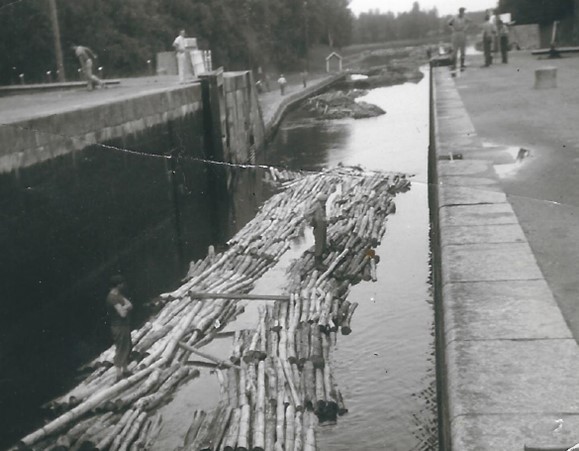
Between the large lakes at different levels of the water system, there were isthmuses or rapids that required the construction of canals. In 1927, the Iisvesi–Konnevesi–Keitele canal route was completed. Later, in 1994, the Keitele–Päijänne canal was completed. Kerkonkoski gained an element that is an essential part of the village's appearance and image: the canal and the swing bridge. There was a traffic sign at the bridge: "30 päiväsakon uhalla kielletään juosten ajo sillalla.When the canal switched to self-service, a new high bridge was built in 1969, which ships could pass under, and the swing bridge was removed. Log floating, log pulling, steamboats, tugboats, and the hustle and bustle of the canal were an essential part of the village's summer life and atmosphere. With the transition from timber floating to wheeled transport, the canal now serves recreational boating.
In the mid-20th century, the village had three shops, a bank, a post office, a health clinic, cafés, a bar, and other services, as well as active cultural, social, sports, and other activities. The school was bustling with competition and excitement. At least ten bus routes a day brought people to and from the village.

What now?
A large proportion of the baby boomers born after the war jumped on one of those ten buses and left their hometowns. They set out to build an urban, industrial society. Each in their own way and in their own field.
Society's values have changed. The world has become globalized. Our daily bread, even our food, does not come from our neighbor's or our own fields. Self-sufficiency is an unknown concept, or at least one that has been forgotten. Our children and grandchildren have adopted today's values. For them, the countryside is nostalgia or an image of warm summer days at the beach sauna, heated by grandpa. Or mosquitoes buzzing around.
Structural change has been evident in Kerkonkoski, as elsewhere in rural areas, and has seemingly taken its toll and led to passivity. Primary production, agriculture, forestry, and fishing have undergone the greatest change. Small farms have disappeared. Agriculture now operates in large units, on an almost industrial scale. Alongside this production, I believe that local production, organic or otherwise, will naturally emerge as a necessity. Low-profile production and micro-entrepreneurship based on expertise and with a reputation that carries far. Summer cottages, vacation homes, and remote work opportunities bring life to the area, provided that the connections really work. Everything requires an open mind and, above all, realism.
As a brief overview of history shows, there have been many different phases, economic cycles, setbacks, upturns, growth, and recession. The driving force has been determination. The spirit of enterprise that is inherent in human nature. That is what carries us forward.
In the 16th century, a few brave pioneers moved to the ancient village of Vesterilä, and the entire village grew from there. We believe that the same courage, open-mindedness, and vision can be found today!