Kerkon Evening Fishing 2024

Kerkon Evening Fishing 2024

Iltapilkki 24

Joy and togetherness in the middle of a long winter 

The Kerkonko Evening Fishing Festival was held for the second time last Saturday, March 9th, in Hietaharju, Kerkonkoski. The event is a joyful demonstration of the volunteer spirit of the people of Kerkonkoski.

The number of ice fishermen participating in the competition was the same as last year, 71 people. The largest catch was 2385g. Ice fishermen ranged from under-school age to senior citizens. The ice fishing competition was held in five different categories and the cash prizes were determined based on the number of participants. Children and young people received prizes in goods.

On the ice of Hietaharju there was also other activities for the whole family on a Saturday in March. Those who wanted to try out tandem skiing, raffle tickets were sold and there was fishing for children. The lovely Vipa horse took us on a sleigh to the seine site to watch the winter seine haul. The fishermen's catch of fish from the seine this time was small, but there was plenty to marvel at in the operation!

Kerkonkoski Evening Ice Fishing originated from the coffees, "business food" of Kerkonkoski entrepreneurs, in the fall of 2022. Kerkonkoski's summer is lively, but in winter, there are few meetings in the village, so we started working together on the idea of ​​a winter event.

Village shop Kosken Puotipiika Café Kuha served sausage, pea soup, wall-bottom pancakes and other delicacies to the event attendees on Saturday. There was a pleasant buzz of conversation at the long tables, as villagers and those from further afield met over a hot cup of coffee. The event organizers were most pleased by the happy faces and the chatter.

Event manager Juha Karppinen describes the talk show: "On Friday, when we gathered, I noticed that the volunteers' batteries and mittens were full of volunteer energy. After the start on Saturday morning, the assembly of the competition site went smoothly, the tents were put up, the Baja hut was moved, the benches, chairs, fire pits, lights, signs and instructions were all quickly placed in their places. It was as if everything had been carefully planned in advance."

Karppinen jatkaa: “There were 45 volunteers in total, most of whom worked in ice fishing and some in Cafe Kuha, Wille's seine or Afterpilkki in Seurala. Not forgetting the ice maintenance team and those who were involved in spirit, the number is rising rapidly. From my perspective, all the teams did their part very well, and I heard from many people that they were satisfied with the arrangements and offerings of the event.”

The event day did not end with the ice fishing competitions, but the evening continued at the Village Hall Seurala. At 6:00 PM, a KeKe-RautU ice hockey match was played on the Seurala field. The battle was tight and the game ended in a 4-4 draw. A large crowd had gathered to cheer on their favorite teams.

The 150 tickets for the After Pilk organized by Kerkonkoski Keitaa were sold out, but even before the tickets went on sale, about 100 people had time to visit the Seurala. In total, well over 200 event guests visited the Seurala during the evening. The theme of the After Pilk was a masquerade, and the prize for the best costume was won by a gorgeous steampunk-style couple (picture). The crowd was entertained by the party band Ninety Show, and the evening continued late into the night to the tunes of DJ MIKSEI.

We would like to thank everyone who participated in the event! Event guests, ice-fishing competitors, hockey players, volunteers, entrepreneurs and sponsors. Together you are the lifeblood of the event! 🙂

Thank you sponsors!

Financially supported by:

Maansiirto Jari Hämäläinen, Sisä-savon Nuohouspalvelut Oy, Suomen Kaapelikaivuu ja Suuntaporaus, SKKS Oy, Autohuolto Miskala, MV-Louhinta Ky, Rautalammin Osuuspankki, Taksi Jämsinen

Those who supported with gift cards and merchandise prizes:

Atoy autohuolto, Auto-apu Auto Oy, Demorec Oy, Eckerö line, Farmarin verkkokauppa, Hessun autopesula, Hankkija Suonenjoki, Huhtalan maatila, Jarmo Lappi, Jukolantila, Kivisalmi Oy, Kerkonkosken Keidas, Kylpylähotelli Kunnonpaikka, K-Rauta Suonenjoki, Kuopion autokauppa, Linda Nissinen, Luottobiili, Mätitalo Oy, Mika Haukka, Rautalammin Neste, Rautalammin kunta, Rautalammin Työppäri Bingo, Ravintola Hetki, Sisä-Savon sähkö, Suonenjoen sähköasennus, Sisustuspiste Martinseni, Tuija Jäntti, Tokmanni Suonenjoki, Vianor, Vesannon auto ja konetarvike, Veera Vuorela, Ämsee Rautalampi, Öljy-Jokeri, Halmetoja & Rinnevuori Oy, Greentrail

Unna's art workshops bring joy, color, and community spirit to Kerkonkoski

People make the village - part 6 of the story series

Picture: Markus Sjöberg 

Unna's art workshops bring joy, color, and community spirit to Kerkonkoski 

Unna Paananen has been creative since childhood and missed opportunities to practice her craft skills in adulthood, during the so-called peak years, until her 16-year entrepreneurial career ended in disability. That's when a new world opened up in art. In 2018, she received a space from the city of Kerava for an open art workshop. The workshop was aimed at working-age people, mainly those with substance abuse and mental health problems. She managed to run the art workshop in Kerava for a couple of years until the corona “closed everything”. The open, low-threshold art workshop proved to be meaningful to its visitors in many ways. – It strengthens, among other things, a sense of self-worth through experiences of success and belonging to a community. Visual arts also allow you to release your emotions and ease your psychological burden if speaking is difficult, says Paananen.


Unna Paananen has been creative since childhood and missed opportunities to practice her craft skills in adulthood, during the so-called Peak years, until her 16-year entrepreneurial career ended in disability. That's when a new world opened up in art. In 2018, she received a space from the city of Kerava for an open art workshop. The workshop was aimed at working-age people, mainly those with substance abuse and mental health problems. She managed to run the art workshop in Kerava for a couple of years until the corona "closed everything". The open, low-threshold art workshop proved to be meaningful to its visitors in many ways. – It strengthens, among other things, a sense of self-worth through experiences of success and belonging to a community. Visual arts also allow you to release your emotions and ease your psychological burden if speaking is difficult, says Paananen.


How did Unna find her way to Kerkonkoski? Unna, who is from Kerava, has been visiting her friend's cottage in Kerkonkoski since 2004, but one rainy autumn evening in the Kerkonkoski harbour, an encounter took place that changed the woman's life. There was a group of people sitting at the harbour's campfire site for the evening, and Unna and her friends joined them. The smoke in her eyes swirled so much that Unna had to change places and soon she found herself next to Toni. The evening lasted until the wee hours of the morning and Unna remembers thinking about her strong feelings at night: "What is this guy really like?" A love at first sight was born, which still lives on today. The engagement was soon announced and in the summer of 2022 the couple's wedding was celebrated at the Kerkonkoski Oasis.

Workshops were held regularly at the Village Hall Society twice a week during Unna's year-long fixed-term employment. If you wanted, you could come to the place just for a coffee and a chat. Sometimes a visitor would get a piece of cardboard that would slowly start to create something beautiful. There was usually no specific theme in the workshops, but visitors had the opportunity to create whatever they wanted within the materials. Unna was there to give ideas and give advice. Unna collected materials and supplies from donations, among other things, and purchased them with money raised through voluntary material payments and small sponsorships. Unna also brought her own craft supplies for the workshop participants to use. Kerkonjoki schoolchildren and daycare center children have also been able to enjoy making art under Unna's guidance. Unfortunately, the wage subsidy ended last June, but the hope for the financial side to be organized lives on. Paananen plans to continue holding art workshops on a voluntary basis from time to time.


Unna playfully calls herself a (p)craftswoman, even though her works seen at the Kerkonkoski Venetians are unparalleled. Last year, the event was put together in less than a month by the villagers, and Unna's light art works aroused great admiration among the villagers and those who came from further afield. The number of event visitors was many times greater than the number of Kerkonkoski residents. This year, a larger group than ever before has participated in creating the works, and Unna is delighted by the excitement.


Kerkonkoski Venetians will be held on 25-27 August 2023. In addition to dazzling light art, there will be a fun program for the whole family. A warm welcome!
More information about the event: www.visitkerkonkoski.fi/ajankohtaista


The author is Johanna Koponen, a project worker for the Kerkonkoski Ketterän Kerkolla Kylään project. The project has received Leader support from the Development Association Mansikka ry.
Photos: Unna Paananen's home album, Wedding photo: Jouni Mattila

The purpose of this feel-good series is to make life in Kerkonkoski visible and bring the villagers closer to each other. The series introduces new and old acquaintances, those who have moved to the village and those who have lived there all their lives.

Pictures: Unna työn touhussa, Emilia Vesterinen
Wedding photo Jouni Mattila

We come here as if to our home

People make the village - part 5 of the story series

Pictures: Johanna Koponen 

We come here as if to our home 

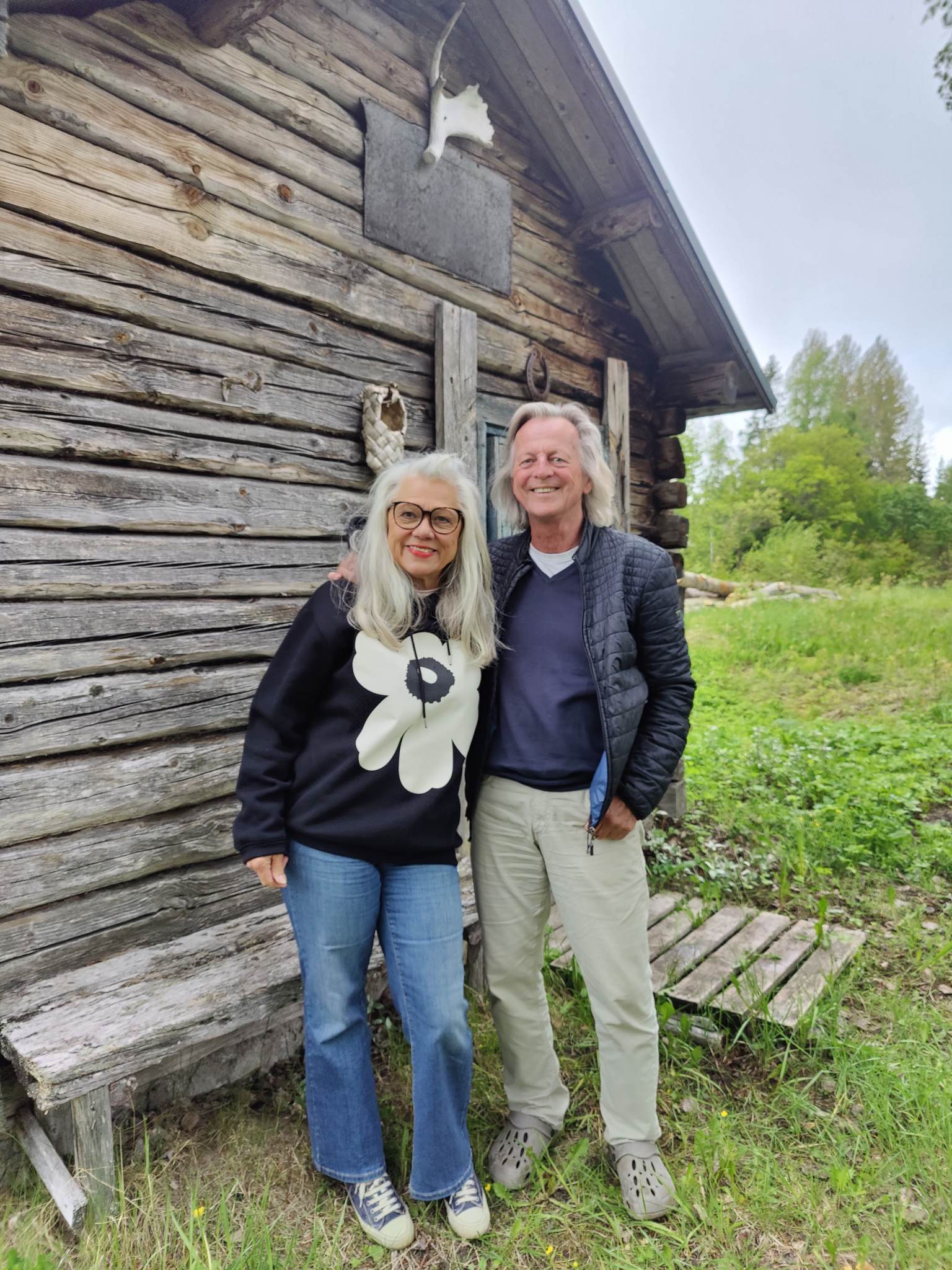
I drive along the dirt road that runs along the banks of the Kerkonkoski canal through an old spruce forest. When I arrive at the yard, a log house rises in front of me, with a small red cottage next to it. I get a hint from a worker who is found in the log house under construction that the host couple can be found in the cottage. I climb a few steps into the cottage and take off my shoes. I am welcomed with a smiling face into the house, whose ragged carpets and the summery light reflecting from the old windows take my thoughts back to the summers of my childhood. As I step inside from the hallway, the cottage’s owner, Peter, looks at my feet and rushes to put on slippers for me. Understanding German a little, I hear Annuka say, “Yes. Here in Finland, we take off our shoes inside.”

We sit in low-backed armchairs at a round table with a lace tablecloth, and I am offered warm tea. I admire the classic 70s-style chairs out loud. Annukka tells me that the chairs came with the cottage and that she has recently had them upholstered by a seamstress from Kerkonkoski. I each sip tea from a decorated porcelain cup and immerse myself in listening to the story of the Enzensberger couple.

When Annukka, a high school student from Lahti, left for Germany in 1970, she probably didn't think that she would end up in that situation. After receiving her Finnish passport, she was able to study at the University of Mainz as a translator. Even before she started her studies, on her trip to Sonthofen, she met a young architecture student, Peter. The affair with the German boy went well right from the start, and soon Peter's mother also invited Annukka and her friends to the village. At the end of the visit, the young people headed to a local disco and Peter invited his cousin along. After all, he couldn't take care of three Finnish girls alone, and it so happened that Annukka's best friend Maija fell in love with Peter's cousin, whom she later married.

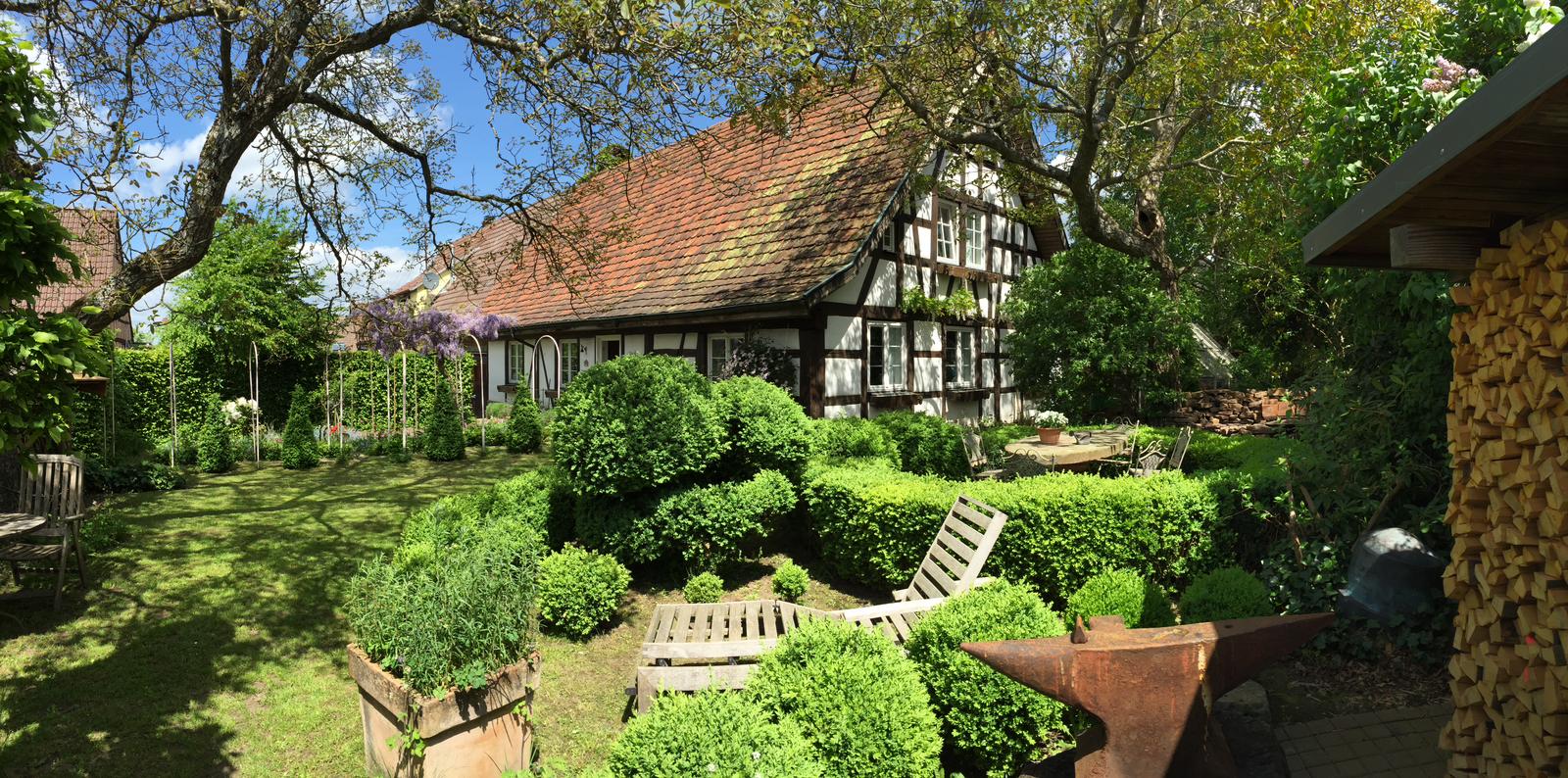
Annukka graduated from the University of Mainz with a diploma in translation, but there were few jobs in the field, so she ended up studying to become a teacher. The couple found their home in the small, picturesque rural village of Schielberg. Annukka worked as a teacher in the small village school in the same village for 30 years. Peter, on the other hand, has had a great career as an architect and has designed a wide range of projects, including the restoration of historical, protected sites, public and industrial buildings, and private houses. The interest in historical buildings is also evident in the Enzensbergers' German home, which is 285 years old and surrounded by a lush garden. Fachwerkhaus i.e. a traditional German half-timbered house.

So what made the couple buy that red cottage in Kerkonkoski? The region was already familiar to the couple, as they had first visited the summer cottage of Maija's parents, Annukka's friend mentioned earlier, for the first time a couple of decades ago. When it was time for Maija to give up her summer place four years ago, Annukka and Peter offered to buy a beautiful waterfront plot with buildings. Even then, they had the idea of ​​building on the same plot, as the current cottage was too small to accommodate the couple's daughter's family and friends. Spending time with loved ones is more precious than gold for the couple.

There were many reasons for purchasing a holiday home. Annukka has always wanted to spend her summer holidays in Finland. Annukka noticed the impact of Finnish holidays while she was working: “When I arrived back in Germany, I felt so peaceful.” With the family’s summer holidays, visits to Finland have also become an important tradition for the couple’s daughter, Mari. After all, Mari now has her own children, whom she shows Finnish life, nature and culture to.

Community is important to the couple. Unlike, for example, in southern Finland, the neighbors in Kerkonkoski are not just neighbors, they have become friends. “It feels like home here. Friends have heated the cottage for us and in the winter the road is plowed all the way to the yard,” Annukka rejoices, and Peter, who is somewhat fluent in Finnish, nods with a smile.

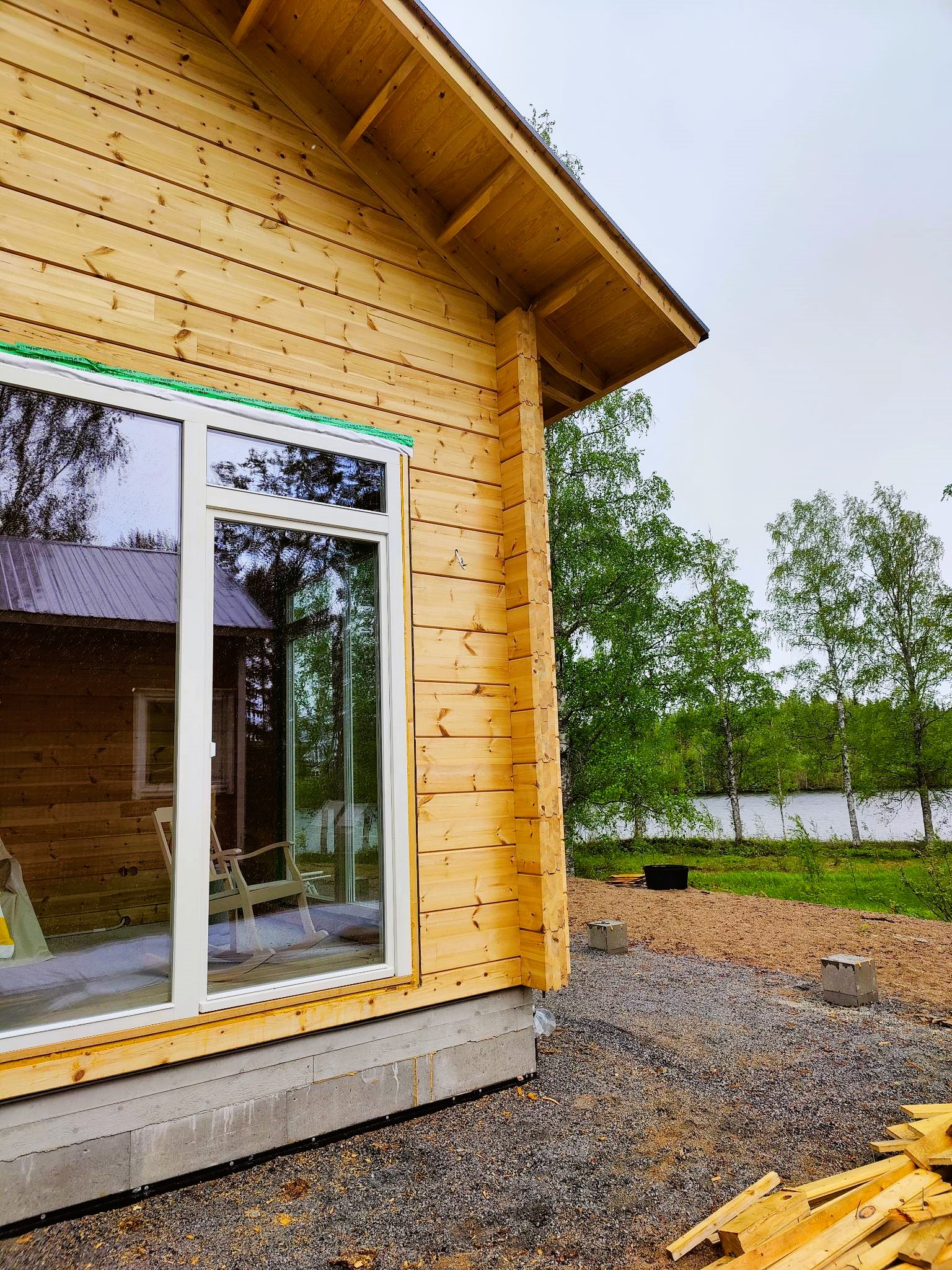
For Peter, designing a log house was an interesting project, as he had never done anything like it in his long career. The starting point for the design was that the building is part of the surrounding nature. The design took into account the cardinal directions, local building style and energy efficiency. Peter respects the framework provided by the environment and wood plays a strong role as a material in the building. The log will not be treated in any way, but will be allowed to grey over time to fit even better into the landscape. He praises that the implementation has gone smoothly with the local construction professionals, their “team”. The work ethic has been impeccable and the work has been done in all weathers. In Peter’s experience, the permit process is rarely as straightforward and friendly as it has been with the Rautalammi building authorities.

German hospitality may have been confusing to the local workers at first. It has become a tradition for the couple to offer the team espresso cups instead of Juhlamokka during the work break. When the house is completed, a crest-raising party is held for the partners. When I ask Peter about the differences in construction between Finland and Germany, he praises the fact that working here is very straightforward and seamless between the different actors. “In Finland, at least in this industry, there is no tipping culture. In Germany, it is customary to give coffee money to suppliers, for example, but here it is mostly surprising,” Peter points out.

Although the house is under construction, the busy Peter, who comes from a family of craftsmen, has already made a vegetable garden on the plot, where potatoes, beans and peas grow, among other things. “Nature and water bodies are so important to us.” Annukka says. This year, the couple was in Kerkonkoski during the sunny spring months in March, and they have also spent early summer on the plot thanks to the construction project. “It’s just so good to be here. It’s like soul yoga when you have time to just be and wonder. Watching woodpeckers build nests and swans home.” Annukka sighs and Peter nods with a smile.

The author is Johanna Koponen, a project worker for the Kerkonkoski Ketterän Kerkolla Kylään project. The project has received Leader support from the Development Association Mansikka ry.
Pictures: Johanna Koponen, Peter Enzensberger

The purpose of this feel-good series is to make life in Kerkonkoski visible and bring the villagers closer to each other. The series introduces new and old acquaintances, those who have moved to the village and those who have lived there all their lives.

Enzensbergerien Saksan koti. Kuva: Peter Enzensberger

Delicious school meals for generations

People make the village - part 4 of the story series

Pictures: Minna Vauhkonen 

Delicious school meals for generations 

Hellu Lappi is a familiar face to many Kerkonkoski residents. She has fed two generations of children in the village. This spring, Hellu turned 22 years old as the cook at Kerkonjoki School, and it was time to retire. The timing was natural, because as the number of students at the school decreased, the food services were also reduced. With the transfer of the welfare area, the food supply for early childhood education, school children and upper secondary school students has been centralized in Rautalammi to Matti Lohi's central kitchen, from which lunch is transported to, among others, Kerkonjoki School.

Hellu used to prepare up to 80 lunches in the school kitchen. There were more students, but lunches were also prepared for the elderly in the village in the school kitchen, from where they were delivered warm to the elderly by a home delivery service. This year, this also changed, as the food services for the elderly were transferred to Servica.

There are challenges in outsourcing catering. Food is fuel for us, and children, if any, demand that it be tasty. It goes without saying that when food is prepared in your own kitchen for a smaller number of people, the quality is more like home-cooked food than ready-made food. Hellu knew and felt the students, and was able to plan the dishes accordingly. After trying some spices, the feedback was immediate and the next time the cook knew how to play it safe. “Pizzas and other things are part of the treat days. Children do know how to appreciate normal home-cooked food,” Hellu points out.

When autumn came, it was easy to get to know new students at Kerkonjoki School. In the small village, many of the children were already familiar to Hellu when they started school. If not, they might at least seem familiar because Hellu had already fed their sisters or even their parents in the past.

The school says: “All the holidays and seasons were reflected in the school canteen and food in many ways. There were chicks and eggs, Runeberg tarts, and on May Day, Hellu baked doughnuts and made mead until it was sold!” As expected, Christmas was also visible and tasted at Kerkonjoki School: “Perhaps the best memories are Hellu’s incredible gingerbread houses. At Christmas, she also made one for the school and decorated a gingerbread for each child in the surprise bag of the Advent calendar. 

"In addition to her work, Hellu dressed the school canteen in a wonderful, Christmassy outfit, and throughout December, small additions were made to the hall. One day a broom appeared on the elf door, and the next day a new Christmas picture appeared in the hall, which was incredibly exciting for the children. The cook also knew how to keep the children "happy", and participated in the educational work by, for example, teaching them how to behave at a Christmas meal and trying new flavors.

The woodcutter woman doesn't seem to have a shortage of things to do even in retirement. Now that time constraints have been lifted, Hellu and her husband enjoy spending long periods of time at their cottage surrounded by a mountain birch forest in Kaamanen, Lapland, on the shores of Lake Syysjärvi. The journey to the cottage is 900 km, but the journey is worth it. Although the Kerkonkoski home is located in a beautiful location on the shores of Riitunlampi, Lapland offers a different way to escape from everyday life. Autumns are spent in the berry and mushroom forest, and the grandchildren are always looked after when necessary. In winter, Hellu's "knitting" kicks in and thanks to that, the family has remained in woolen socks. With six children and ten grandchildren, she even manages to knit a few pairs of socks.

It goes without saying that this everyday hero has remained in the fond childhood memories of many Kerkonkoski residents. Kerkonkoski thanks her for the past years and wishes Hellu a very enjoyable and busy retirement!


The author is Johanna Koponen, a project worker for the Kerkonkoski Ketterän Kerkolla Kylään project. The project has received Leader support from the Development Association Mansikka ry.

The purpose of this feel-good series is to make life in Kerkonkoski visible and bring the villagers closer to each other. The series introduces new and old acquaintances, those who have moved to the village and those who have lived there all their lives.

Huttula's life

People make the village - part 3 of the story series

Pictures: Johanna Koponen 

Huttula's life 

When visiting the village of Kerkonkoski, you can't help but gaze at the Huttula farm. In the summer, it stands peacefully amidst dandelion fields. In the winter, Huttula is like a small island from a bygone era, surrounded by a white blanket of snow.

The history of the main house that stands on the plot today dates back to 1882, but the history of the Huttula farm is even older. Along the Kerkonkoski Canal The book says that the current light blue-gray house is not the original main building of the farm, but a large log house stood next to it in the 18th century. That red-earthed house was demolished in the 1940s, when the brothers on the farm divided the property in half. The Vataja farm was built from the logs and the fields and cows were divided equally. The first Markkanen, Juho by name, settled in the house in 1851 when he married the farm's daughter, Erika Hänninen. From those years until today, the mailbox has been adorned with Markkanen's name.

Sitting across from me at the coffee table are Olli and Päivi Markkanen, the former owners of the farm. Olli was born and raised on the farm. He says he always knew he wanted to be a farmer, and he completed his studies at the Suonenjoki Agricultural School. As his life progressed, Olli felt that something was missing from his rural landscape. Päivi, who had faced challenges elsewhere in her life, asked her late mother: “If you hear my prayer, send me someone I can live with.”

Päivi and Olli's paths crossed in 1985. It's been a long time, but the warm love between the couple still blossoms. It was July when Päivi was driving from a trip to Lapland with her daughter Laura on the 5-way towards her home in Kerava. Since the trip was long, she decided to point the front of the Datsun 100A towards Juankoski, where her family lived. Päivi's sister was also there, and when evening came, the sisters and their cousins ​​were excited to go see what was going on in the village. They headed to a local restaurant and were met at the door by a doorman who announced that the restaurant was reserved for two weddings. After a little negotiation, the doorman let the girls in, but swore them not to tell which wedding party they were in.

It wasn't long before Päivi was the bravest, peeking out from the door of the ballroom despite the snickering of her friends. Little did Päivi know that at that moment the pages of the rest of her life were being written in big leaps. Olli was a wedding guest at the party in question, and he caught sight of a woman peeking in from the other side of the hall. He said out loud: "That's it."

Päivi's lively energy captured the young man's heart, and Päivi remembers Olli wondering: "What exactly are you?" From that evening on, they continued to get to know each other between Kerkonkoski and Kerava using landline phones, and it was noticed that things were going very well. In October of the same year, Olli traveled to Päivi's place in Kerava, and at the turn of the year, they celebrated their engagement in Kerava.

In Kerkonkoski, Päivi was charmed by the fields bathed in autumn colours and the beauty of the canal area. Before visiting Kerkonkoski, Päivi had no idea how big the Huttula estate was. There was plenty to do and Päivi's modern ideas about floor mopping did not please the then mistress of the house. "The floor in the cottage has always been washed from top to bottom, and they always come to wash it," said her mother-in-law. Päivi humbly accepted her mother-in-law's advice, but when she started washing the floor, she heard from behind her: "And I've never started from that corner!" Her mother-in-law didn't let her daughter-in-law off easy, but Päivi, who had already experienced hardships in her life, did not give up. As you might guess, settling into a large house in a rural village as the daughter-in-law was not easy for a single parent who had moved from southern Finland in the 1980s.

Despite everything, Olli and Päivi's love carried them through the difficulties unshakably and the wedding was celebrated in the summer of '86. The wedding ceremony was held in Rautalammi Church, from where they moved to Huttula for coffee. When evening came, they went to the village house Seurala, which stands on the other side of the field. A couple of years passed. The family grew and Laura had a long-awaited little brother, Sampo. Later, the current owner of the farm, Alpo, announced his arrival.

There was plenty of work to do on the dairy farm, but as a hardworking and sociable woman, Päivi also joined the Kerkonkoski village committee. She wanted to find her place in the village community, and so friendships gradually began to form. The volunteer group achieved many things, and in the 90s, smart heads were brought together on a project basis when the Kirjava satama event was established in Kerkonkoski. During those summers, thousands of visitors flocked to the small village, and the event gained a national reputation.

This year, Päivi and Olli corked a bottle of sparkling wine to celebrate their engagement anniversary at their home in the parish of Rautalammi. No stone grows moss on a rolling stone, and the couple is actively involved in volunteer work. They also occasionally help their youngest son with Huttula's work.

The current owner of the farm, Alpo, works full-time as a paramedic in Varkaus, but he doesn't want to give up his home. Alpo uses his free time to work in the fields and go out into the forest, both for forestry and hunting. After a hectic workweek, it's nice to come home to the peace and quiet of the countryside. "Where else can I go from here?"


The author is Johanna Koponen, a project worker for the Kerkonkoski Ketterän Kerkolla Kylään project. The project has received Leader support from the Development Association Mansikka ry.

Pictures: Johanna Koponen ja Markkasten kotialbumi

The purpose of this feel-good series is to make life in Kerkonkoski visible and bring the villagers closer to each other. The series introduces new and old acquaintances, those who have moved to the village and those who have lived there all their lives.

For the love of engines

People make the village - part 2 of the story series

Pictures: Johanna Koponen 

For the love of engines 

Many people know that Kerkonkoski has several smaller villages, one of which is the village of Repola. Sami Hämäläinen also lives there, whom our story wizard hit this time. I turn into the yard on a snowy road that runs alongside the fields. It is a rare sunny December morning and Sami has just finished clearing the snow in the yard with his old and faithful tractor.

 There are two houses and a large barn on the plot. There are no cows or other animals in the yard, but even a quick glance shows that the barn has been renovated. I step onto the porch of the relatively new house and knock on the door. Sami greets me cheerfully and invites me in. The oven is roaring with fire.

Sami was born in Rautalampi, but has also lived in Suonenjoki. As a child, he spent a lot of time on the farm, where he built his current home in 2014. The place is dear to him, because the house next door is his father's childhood home and was built by his father. Sami points to the window and I see a red house and a few other buildings on the other side of the field: "And that's where my father lives."

 Hämäläinen became an entrepreneur in 2007. Sami's employer at the time had his hands full and offered Sami one of his trucks. The deals came and since then Sami's company, Hämy Trans Oy, has expanded. The company currently owns five trucks of various sizes, from full trailers to fish transport trucks, which Sami has built and equipped to suit the needs of his customers. The man's thumb is certainly not in the middle of the palm of his hand and he is also a partner in a heavy equipment sandblasting, painting and repair company.

Hämy Trans transports wood chips, sawdust, sawn timber and pulp. Special and machine transports as well as crane transports are also handled. The company's operations specialize in the transport of live fish. Fish and their fry, from rainbow trout to sea trout, are transported by Hämy Trans mainly in Finland, even as far as the Åland Islands. Fish has also been delivered to Russia, but due to the corona and the war, the trips to the eastern border have stopped. Fortunately, a replacement activity has been found. "And I don't miss the constant border hassle," says Sami.

It could be said that domestic tourism also affects Sami's business. Hämy Trans Oy was one of the companies that was positively affected by the corona. With the pandemic, domestic tourism grew and especially hiking and walking in nature increased in popularity. So did fishing tourism and the demand for fish, for example, in rapids and river locations. Consequently, Hämy Trans's trips also increased.

Summer is the busiest time for Sami's company, but he also has time for his beloved hobby – Jokkis, or Everyman's Class racing. Last summer, Hämäläinen managed to compete in about six competitions. In the best years, there have been 15 of them. There is a row of jokkis cars under the canopy in the yard, and the old barn has also come into use. Several vehicles are revealed behind the door, and there are also some vehicles used for road traffic. I wonder if even the fingers of two hands are enough to count the cars and there is enough "project".

The best thing in the sport is of course winning, but success is also having built a racing car with your own hands that works and sometimes even works well. However, it is not a good idea to form too strong an emotional bond with the cars, because Jokkis' specialty is that the competing cars are sold after the race. Last season, the cars changed hands for €2,000. Sami thinks that the good team spirit makes the hobby enjoyable, and if necessary, spare parts can be found in the pits from a competitor.

Sami's roots are in Kerkonkoski and it's a good place to be. Life in the country is simple, as the man says. It's convenient when you can store the company's equipment on your own plot and one of the biggest customers, Savo taimen, is nearby. In winter, when the rush of work eases, the best thing to do is take a snowmobile and blast off on the nearby trails, dusting the snow behind you.

The author is Johanna Koponen, a project worker for the Kerkonkoski Ketterän Kerkolla Kylään project. The project has received Leader support from the Development Association Mansikka ry.

The purpose of this feel-good series is to make life in Kerkonkoski visible and bring the villagers closer to each other. The series introduces new and old acquaintances, those who have moved to the village and those who have lived there all their lives.